Tell us about the job
Takes about a minute. No obligation.
A furnace quote for a home in Warren County starts with what the climate actually asks of the equipment, because that shapes both the system a contractor specifies and how they set it up. 132 severe weather events were recorded in Warren County, Virginia between 2015 and 2024. Severe weather at that rate is a standing condition here, and a contractor sizing a furnace accounts for it: undersized equipment runs hard and wears faster, while a system matched to real local demand runs closer to the conditions it was built for. That sizing call is specific to this area.
Ductwork designed for an older system carries assumptions about airflow, return paths, and branch sizing that a new furnace will test immediately. Half the homes in Warren County, Virginia were built in 1986 or earlier (2020-2024 ACS 5-year). That history means a contractor assessing a furnace installation here has to look at what the ducts actually do before pricing the unit, because ductwork that was routed for different equipment may need rebalancing or partial replacement to move air the way a modern furnace expects. The electrical service is a second check: older panels were not always wired for the controls and blower loads current equipment draws.
What a Furnace Installation Puts in Your Home
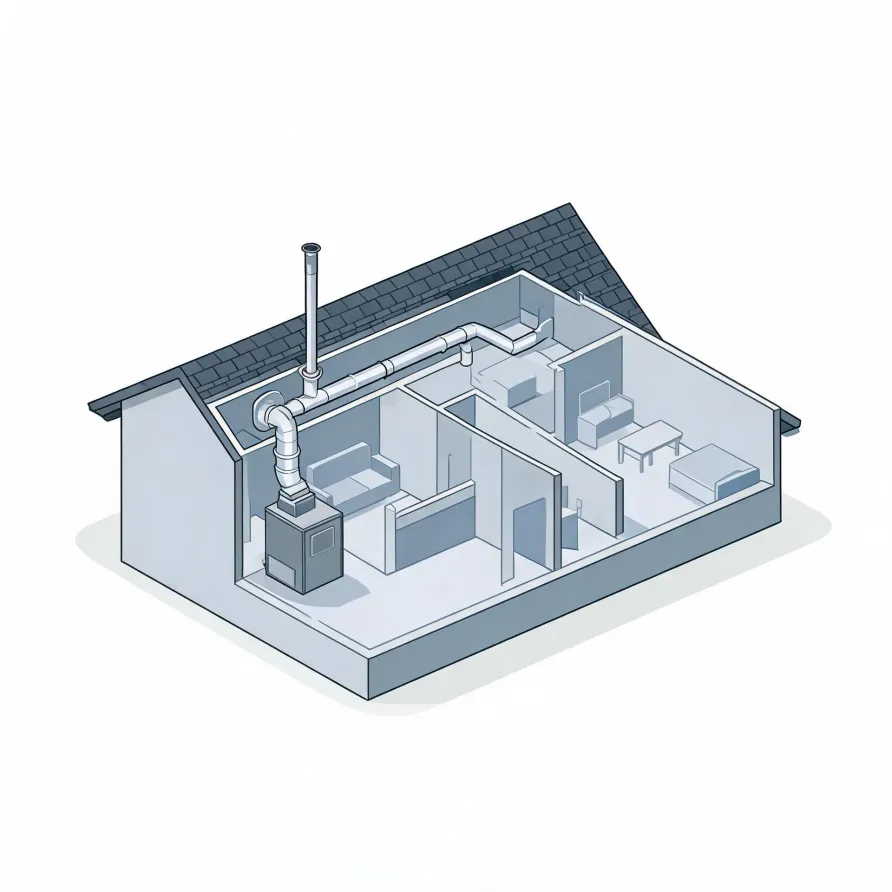
The furnace itself sits inside the house, most often in a basement, utility room, or closet. It holds the heat exchanger and the blower, which together warm the air and push it through the house. The flue pipe runs from the furnace to an outside wall or up through the roof, carrying combustion exhaust out.
The thermostat mounts on a wall in the living space and tells the furnace when to run. Alongside the furnace you will find the air handler or a coil cabinet if a cooling system shares the installation, and a condensate drain line runs from that coil to a floor drain or pump.
The drawing shows the typical layout of these components, and a licensed contractor determines exactly what applies to your house and its existing setup.
Get matched in Warren CountyWarren County, Virginia, by the numbers
132 severe weather events were recorded in Warren County, Virginia between 2015 and 2024.
NOAA National Centers for Environmental Information, Storm Events Database, bulk CSV export, events 2015-01-01 through 2024-12-31.Half the homes in Warren County, Virginia were built in 1986 or earlier (2020-2024 ACS 5-year).
U.S. Census Bureau, 2020-2024 American Community Survey 5-Year EstimatesWarren County, Virginia holds 17,064 housing units (2020-2024 ACS 5-year).
U.S. Census Bureau, 2020-2024 American Community Survey 5-Year EstimatesOwners occupy 75.9% of the occupied homes in Warren County, Virginia (2020-2024 ACS 5-year).
U.S. Census Bureau, 2020-2024 American Community Survey 5-Year EstimatesCodes & Standards Governing Furnace Installation in Warren County, Virginia6 sourced rules and standards
What the Installation Actually Looks Like
Non-weatherized gas furnaces manufactured on or after November 19, 2015 must reach 80.0 percent AFUE.
Non-weatherized oil-fired furnaces manufactured on or after November 19, 2015 must reach 83.0 percent AFUE.
Mobile home gas furnaces manufactured on or after November 19, 2015 must reach 80.0 percent AFUE.
Non-weatherized gas furnaces manufactured on or after December 18, 2028 must reach 95.0 percent AFUE, up from the 80.0 percent minimum that applies to units manufactured before that date.
Licensing and Legal Requirements in Warren County, Virginia
Virginia’s contractor licence classes start above $1,000: the entry class covers a single contract or project over $1,000 but less than $30,000, or less than $250,000 of work in any 12-month period, with larger classes above that.
Virginia requires a contractor licence: no person may engage in, or offer to engage in, contracting work in the Commonwealth without one.
Severe Weather Events in Warren County
Extreme weather puts a hard load on heating equipment, and Warren County's climate is not uniform from year to year. A furnace sized and installed for local conditions holds up better than one spec'd to a national average.
132 severe weather events, 2015–2024. Source: NOAA National Centers for Environmental Information, Storm Events Database.