Tell us about the job
Takes about a minute. No obligation.
A contractor quoting a furnace installation in Smyth County has to account for what the equipment will actually run against before settling on a size or a specification. 111 severe weather events were recorded in Smyth County, Virginia between 2015 and 2024. Severe weather at that rate is a standing feature of the operating environment, and it bears directly on how hard a heating system has to work and how it should be set up to handle sustained demand. A unit sized for a milder load will cycle harder, wear faster, and fall short on the coldest stretches. That is what a local contractor prices around.
Ductwork laid in when a house was first built carries the assumptions of whatever heated it then. Half the homes in Smyth County, Virginia were built in 1973 or earlier (2020-2024 ACS 5-year). A furnace installed today draws on different airflow requirements, and whether the existing trunk lines and branch runs can support that is the first thing a contractor has to settle before the equipment selection means anything. If the ductwork cannot carry the new load, the install price and the project scope change. The electrical service gets the same look, since a panel sized for an older system may not be wired for what a modern furnace pulls at startup.
What a Furnace Installation Covers
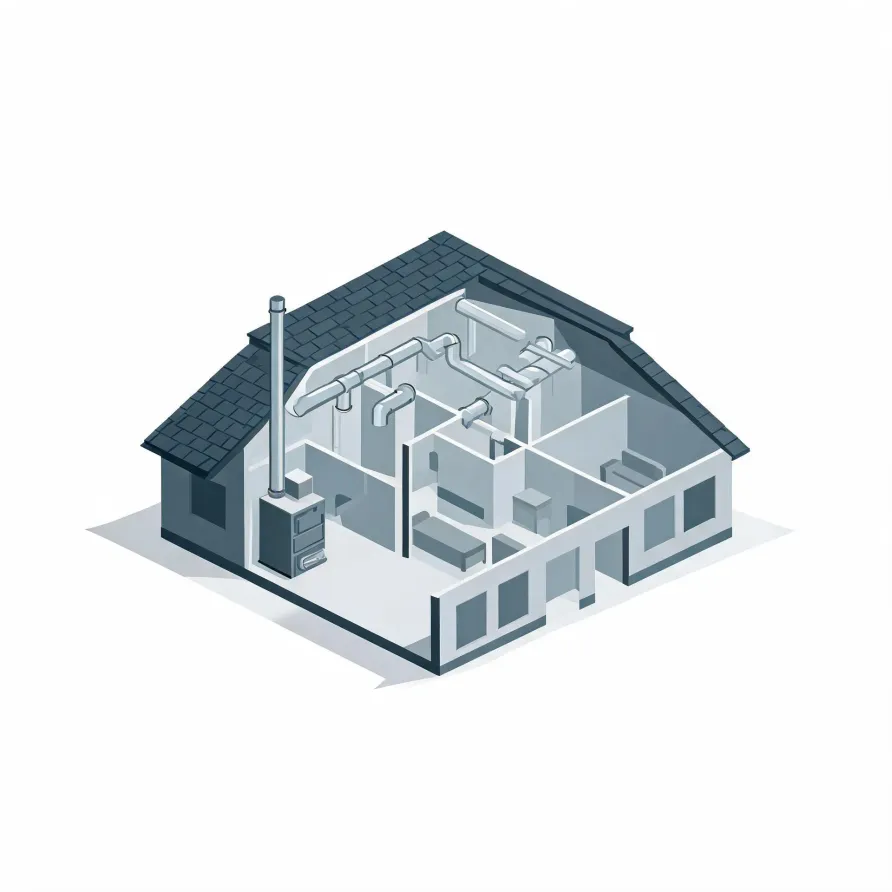
The furnace itself sits inside the house, most often in a basement, utility room, or closet. It is the central unit that produces heated air and pushes it into the distribution system. A new installation also includes the flue or vent pipe that runs from the furnace to the outside, carrying combustion gases out of the living space.
The air handler components built into the furnace work alongside a thermostat mounted on a wall inside the house, which tells the system when to run and when to stop. A new furnace also connects to a filter housing, positioned at the return-air intake, that keeps debris out of the equipment.
The drawing shows a typical layout, and a licensed contractor determines exactly which components apply to your house and how they connect.
Get matched in Smyth CountySmyth County, by the numbers
111 severe weather events were recorded in Smyth County, Virginia between 2015 and 2024.
NOAA National Centers for Environmental Information, Storm Events Database, bulk CSV export, events 2015-01-01 through 2024-12-31.Half the homes in Smyth County, Virginia were built in 1973 or earlier (2020-2024 ACS 5-year).
U.S. Census Bureau, 2020-2024 American Community Survey 5-Year EstimatesSmyth County, Virginia holds 15,080 housing units (2020-2024 ACS 5-year).
U.S. Census Bureau, 2020-2024 American Community Survey 5-Year EstimatesOwners occupy 71.0% of the occupied homes in Smyth County, Virginia (2020-2024 ACS 5-year).
U.S. Census Bureau, 2020-2024 American Community Survey 5-Year EstimatesCodes & Standards Governing Furnace Installation in Smyth County, Virginia6 sourced rules and standards
What Installation Day Looks Like
Non-weatherized gas furnaces manufactured on or after November 19, 2015 must reach 80.0 percent AFUE.
Non-weatherized oil-fired furnaces manufactured on or after November 19, 2015 must reach 83.0 percent AFUE.
Mobile home gas furnaces manufactured on or after November 19, 2015 must reach 80.0 percent AFUE.
Non-weatherized gas furnaces manufactured on or after December 18, 2028 must reach 95.0 percent AFUE, up from the 80.0 percent minimum that applies to units manufactured before that date.
Licensing and Legal Requirements in Smyth County, Virginia
Virginia’s contractor licence classes start above $1,000: the entry class covers a single contract or project over $1,000 but less than $30,000, or less than $250,000 of work in any 12-month period, with larger classes above that.
Virginia requires a contractor licence: no person may engage in, or offer to engage in, contracting work in the Commonwealth without one.
Severe Weather Events in Smyth County
Weather puts a measurable load on heating equipment, and that load is a local variable. What furnaces in Smyth County face shapes what size and grade of equipment makes sense here.
111 severe weather events, 2015–2024. Source: NOAA National Centers for Environmental Information, Storm Events Database.