Tell us about the job
Takes about a minute. No obligation.
A furnace installation in Buckingham County is a local sizing problem, not a generic one. 136 severe weather events were recorded in Buckingham County, Virginia between 2015 and 2024. At that rate, the system a contractor puts in will spend its working life cycling against real weather pressure, not occasional cold snaps, which means duct layout, equipment capacity, and installation quality all have to be matched to what this area actually demands rather than to a regional average that smooths the hard weeks away.
Ductwork laid down for an earlier generation of furnaces carries assumptions about static pressure, trunk sizing, and branch routing that a modern unit does not share. Half the homes in Buckingham County, Virginia were built in 1990 or earlier (2020-2024 ACS 5-year). A contractor quoting a furnace replacement here opens the duct system before settling on equipment, because a box that delivers more heat than the existing runs can distribute will short-cycle and leave rooms cold regardless of its efficiency rating. The electrical service gets the same check: a system drawing what current equipment draws may need a dedicated circuit the original installation never included.
What a Furnace Installation Puts in Your Home
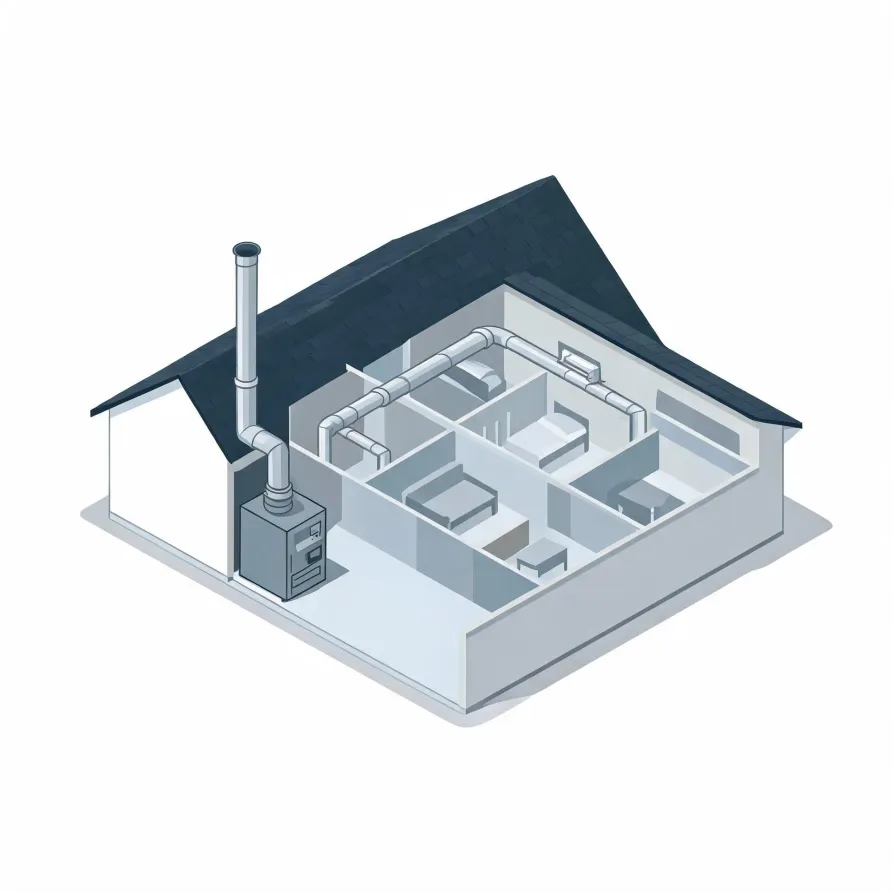
The furnace itself sits inside the house, most often in a basement, utility room, or closet. It pulls air from the living space, heats it, and sends it back out. A flue pipe runs from the furnace to an exterior wall or through the roof, carrying combustion gases outside.
The air handler and blower components work alongside the furnace to move conditioned air into the duct system. A thermostat mounts on an interior wall and gives you control over when the furnace runs. Where central cooling is part of the same installation, an outdoor condenser unit sits on a pad beside the house and connects to the indoor equipment.
The drawing here shows a typical layout, and a licensed contractor determines exactly which components and configurations apply to your home.
Get matched in Buckingham CountyBuckingham County, by the numbers
136 severe weather events were recorded in Buckingham County, Virginia between 2015 and 2024.
NOAA National Centers for Environmental Information, Storm Events Database, bulk CSV export, events 2015-01-01 through 2024-12-31.Half the homes in Buckingham County, Virginia were built in 1990 or earlier (2020-2024 ACS 5-year).
U.S. Census Bureau, 2020-2024 American Community Survey 5-Year EstimatesBuckingham County, Virginia holds 7,284 housing units (2020-2024 ACS 5-year).
U.S. Census Bureau, 2020-2024 American Community Survey 5-Year EstimatesOwners occupy 77.3% of the occupied homes in Buckingham County, Virginia (2020-2024 ACS 5-year).
U.S. Census Bureau, 2020-2024 American Community Survey 5-Year EstimatesCodes & Standards for Furnace Installation in Buckingham County, Virginia6 sourced rules and standards
What happens on installation day
Non-weatherized gas furnaces manufactured on or after November 19, 2015 must reach 80.0 percent AFUE.
Non-weatherized oil-fired furnaces manufactured on or after November 19, 2015 must reach 83.0 percent AFUE.
Mobile home gas furnaces manufactured on or after November 19, 2015 must reach 80.0 percent AFUE.
Non-weatherized gas furnaces manufactured on or after December 18, 2028 must reach 95.0 percent AFUE, up from the 80.0 percent minimum that applies to units manufactured before that date.
Licensing and Legal Requirements in Buckingham County, Virginia
Virginia’s contractor licence classes start above $1,000: the entry class covers a single contract or project over $1,000 but less than $30,000, or less than $250,000 of work in any 12-month period, with larger classes above that.
Virginia requires a contractor licence: no person may engage in, or offer to engage in, contracting work in the Commonwealth without one.
Severe Weather Events in Buckingham County
Weather conditions in Buckingham County put real demands on heating equipment, from temperature swings that force frequent cycling to storm activity that stresses systems already running hard. How much load a furnace carries over its life is shaped by where it lives, and that makes local weather data relevant to any installation decision here.
136 severe weather events, 2015–2024. Source: NOAA National Centers for Environmental Information, Storm Events Database.